Tom Conner, Madeleine Clinton
The Baltimore Hilton and Towers was the site of the first National Even Start Academy this year. The featured presenters were Dr. Peter Mangione, Co-Director of WestEd's Child and Family Studies, and Mrs. Diane Trister-Dodge, founder and President of Teaching Strategies, Inc. . Unfortunately, Ms. Janet Dean, Clinical Director of the Community Infant Program in Boulder, Colorado, was unable to attend due to the death of her mother.Dr.Mangione discussed "Brain Development from Birth to Three." He used a variety of graphics to show the various stages of brain development from the physiological to the emotional. In addition he highlighted the hierarchy of brain development and explained the key points of brain organization. Dr. Mangione explained the critical impact of chronic stress and violence on a child's brain and its emotional development. He described the impact on a child's body chemistry that may cause emotional problems and cited as an example the hormone Noradrenaline. At high levels this hormone can trigger over arousal and acts of violence.
Dr. Mangione emphasized the newness of brain research noting that over 97% of those involved in this research are still living. Technology, he stated, is the key to enabling researchers to provide extensive information regarding the brain. He cautioned readers to understand that there remain misconceptions about the results of many studies and provided the participants with handouts and a comprehensive "Brain Development Resource List."
Mrs. Diane Trister-Dodge conducted an interactive session entitled, "Using Current Brain Research to Create a High Quality Program/Curriculum for Infants and Toddlers." She outlined the Components of Quality Infant/Toddler Care including promoting health and safety, small group work, primary caregiver assignments and cultural and linguistic continuity.
Ms. Trister-Dodge discussed the importance of defining the curriculum for infants and toddlers. Building relationships and understanding the influence of culture were also important topics of the presentation. She provided an outline of goals and objectives for caregivers and teachers as well as children. Participants were provided with grids, which had titles such as "Hellos" and "Good-byes". During the exercise individuals were asked to observe what happened during the "Hello" and "Good-bye" between child and parent.
Responses were also requested concerning what the child may be experiencing, what the parent may be experiencing, and how the caregiver could respond. This exercise was repeated for infants, mobile infants and toddlers. It provided the group with the opportunity to think about parent/child/caregiver interactions.Pat McKee, Even Start Group Leader from the United States Department of Education and co-sponsor, was able to spend some time at the Academy. She provided an update on Even Start and voiced her support for the work of NESA and the Academy.
The Crowne Plaza Hotel & Resort in Las Vegas was the site of the second Academy. Dr. Mangione and Diane Trister-Dodge were featured speakers, as well as Janet Dean. Ms. Dean spoke on the topic: Parent-Infant Attachment, Feeding and Growth and Intervention Strategies. She outlined steps for increasing observation skills during parent-infant interactions. These included understanding the difference between what you actually see and what you think you see as well as focusing on the repeated patterns that occur which are more important than single observations. She discussed emotional availability of both parent and infant/child, then various intervention strategies used in promoting positive parent-infant interaction. Major tasks involved in intervention strategies are providing knowledge of choices, perceiving strengths and adaptations, creating consistent, predictable relationships, and understanding value conflicts. Dean concluded with the Principles of Practice - the basis for the work done with infants and their families. The first and foremost being do no harm, keeping in mind how one's involvement is affecting the situation. She touched on the ambivalence the parents typically feel towards intervention. For that reason, there is a need to present one's self with an attitude of respect and trust. Behavior, she stressed, is the key. Thus, it is more important to be an observer than to immediately intervene. The session was comprehensive in its coverage and helpful for both those interested in family-infant relationships as well as those actual providing families with support.
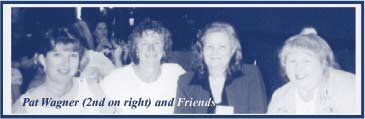
Academies can be rewarding in more ways than one. One lucky attendee, Pat Wagner, from the Adams County Even Start, reported that she and her friends (pictured with her at the Academy) took a trip into Las Vegas to see the Circus Acts at Circus Circus and played a few quarter slots on the way. With her second $20 and one try she hit a jackpot of $33,916.72. She says, "I won't be going to Disneyland, but will replace my old car which is on its last legs."